Q&A with PhD Alumni Narmin Tartila Banu
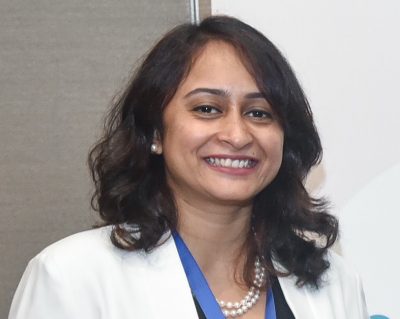
Narmin Tartila Banu was working in the corporate sector when she found herself asking bigger questions about the purpose of her work, the impact it was having, and where it all fit into the bigger picture. Those questions eventually led her to pursue a PhD at the Sprott School of Business and, ultimately, to a faculty position at the University of Northern Iowa. This is an edited conversation about that journey.
You finished your PhD and started a faculty job at almost the same time. What was that period like?
It was certainly a whirlwind. I received a faculty job offer before I had defended my dissertation, and then my husband and I had just six days to pack up the home we’d lived in for six years and move to the United States. I got to my new institution in August, found out mid-month what I was teaching, and classes started on the 24th. My defence was in September, so I was already in the middle of the job while still finishing the dissertation.
People often ask what it felt like to finally complete my doctorate. I usually laugh because there wasn’t really a moment to pause and take it all in. By the time I defended, I was already immersed in my new role. The transition happened so quickly!
Did the transition to independent researcher feel abrupt?
Not at all. It was a gradual process rather than a single defining moment. There wasn’t one day when I suddenly thought, “Now I’m a researcher”. Instead, my way of thinking evolved over the course of the program.
One piece of advice from my supervisor, Lindsay McShane, has always stayed with me. Early in my PhD, she told me that I approached problems like a manager: identify an issue and solve it. Research, however, requires a different mindset. Before looking for solutions, you have to understand how a problem fits within existing theory, identify what the literature already tells us, and determine where the gaps lie. Learning to think that way was a shift I experienced during my doctoral studies.
Over time, I learned not only how to think like a researcher but also how to engage with research as one. In the early years, Lindsay played the role of a mentor, challenging my assumptions, asking questions, and helping me develop a research-oriented way of thinking. As I grew more confident, that relationship evolved. By the end of my PhD, she had become less of a mentor and more of a collaborator working alongside me.
Your research has spanned several areas. How do you make sense of that?
Honestly, it all comes to consumer wellbeing. That’s the thread.
I began my career in brand management where I found myself asking questions about the purpose of my work. Was marketing simply about improving the bottom line, or could it also improve people’s lives and contribute positively to society? A documentary highlighting the amount of plastic waste we generate was a turning point for me. Around the same time, I took a sustainability course during my MBA at the National University of Singapore, which introduced me to the area of sustainability marketing. Those experiences ultimately led me to pursue a PhD at Sprott, where my dissertation examined how to make pro-environmental messages more effective.
My more recent work on AI in healthcare is driven by the same underlying motivation. During a visit to the emergency room in Ottawa, my husband waited seven hours to be seen for a broken finger. Sitting there, I couldn’t help wondering whether emerging technologies such as AI could make healthcare systems more efficient.
So, while the contexts have changed but the underlying question has remained consistent: how can marketing and technology be used to improve people’s lives?
Was there anything about Sprott that you only came to appreciate after leaving?
The support, honestly. And I mean that in a very specific way, not a vague way. Anytime I needed something, whether it was funding for a conference, help navigating a process, or even just a question for the admin office, someone would either sort it out or connect me to the right person. I didn’t fully realize that was not universal until I was somewhere else.
My supervisor supported me through several conferences in the U.S. and one in Paris. I was sitting at the same tables as people from Harvard and Wharton. That kind of exposure matters, and Sprott made it possible.
What would you tell someone starting a doctoral program at Sprott?
Lean into the community around you. One of Sprott’s greatest strengths is its people. The faculty and staff genuinely want their students to succeed, and they’re incredibly generous with their time, knowledge, and support.
That said, a PhD is ultimately your journey. No one can do the thinking, the writing, or the perseverance for you. You have to take ownership of your work and be willing to put in the effort. At Sprott, people are genuinely invested in helping students succeed. Match that support with your own commitment, and you’ll make the most of the community that has welcomed you.