Exploring the Future of Business at Sprott Career Expo
Industry leaders, employers and Carleton University business students gathered in the Nicol Building on Monday, January 12 for the Future Forward: Business Career Expo, organized by the Sprott School of Business. The event fostered connections and sparked conversations about careers, industry trends and what the future of business demands from the next generation of talent.
Students had the opportunity to attend two panel discussions, where industry leaders shared insights into the forces shaping the future of business and the skills needed to succeed in a fast-changing business environment.
The first panel, “AI in Business: Ethics, Skills and Human Collaboration in Business,” focused on the risks, governance and the human impact of AI for business. The discussion drew on the expertise of the panelists: Patrick van Abbema, Senior Cyber Project Manager, Bank of Canada; Nusa Fain, Sprott Assistant Professor, Entrepreneurship; Eric Forsyth, Director, Service Management Office, Payments Canada; and Gavin Simone, Managing Director and Owner, Practice PPE Exams.
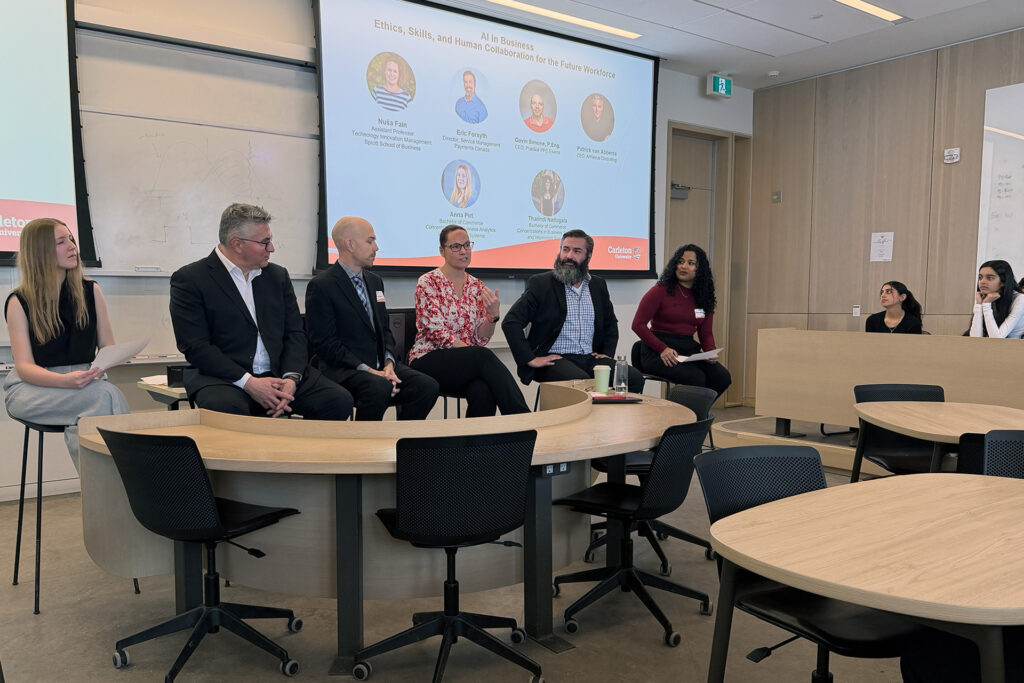
The panelists agreed that individuals often put too much trust in the AI outputs. They advised students to be weary the information that AI tools provide, knowing that AI outputs can be incorrect, and to be analytical in how they frame prompt questions as we communicate with bias which impacts the results.
Fain cautioned, “AI is your intern. You are accountable for its work.”
The panel identified essential skills that students should develop in the age of AI, which included critical thinking, communication, data literacy and leadership.
“Business doesn’t happen in a computer,” said Forsyth. “Business happens in the real world.”
Students were advised to hone their critical thinking skills by reading and dedicating time to skill development. For example, define a problem and create a solution, then have AI generate a solution and compare and critique both.
Staying up-to-date on AI tools is also important. Discover new tools and experiment with them.
The second panel, “Designing Dynamic Careers in Business: Adapting to an Evolving Career Landscape”, explored skills for career agility, lifelong learning and developing an entrepreneurial mindset. The following panelists provided their insights to student attendees: Lorena Caputo (MBA/23), Manager, Organizational Design and Transformation, Deloitte; Kathy Mulzer, Vice-President, HR Strategy, EDC; Andrew Shagen (MBA/21), President, Leverde; Pierce Ujjainwalla (BIB/07), Co-founder and CEO, Knak; and Sasha Valgardsson (BIB/19), PhD in Management candidate, freelance motion and graphic design.
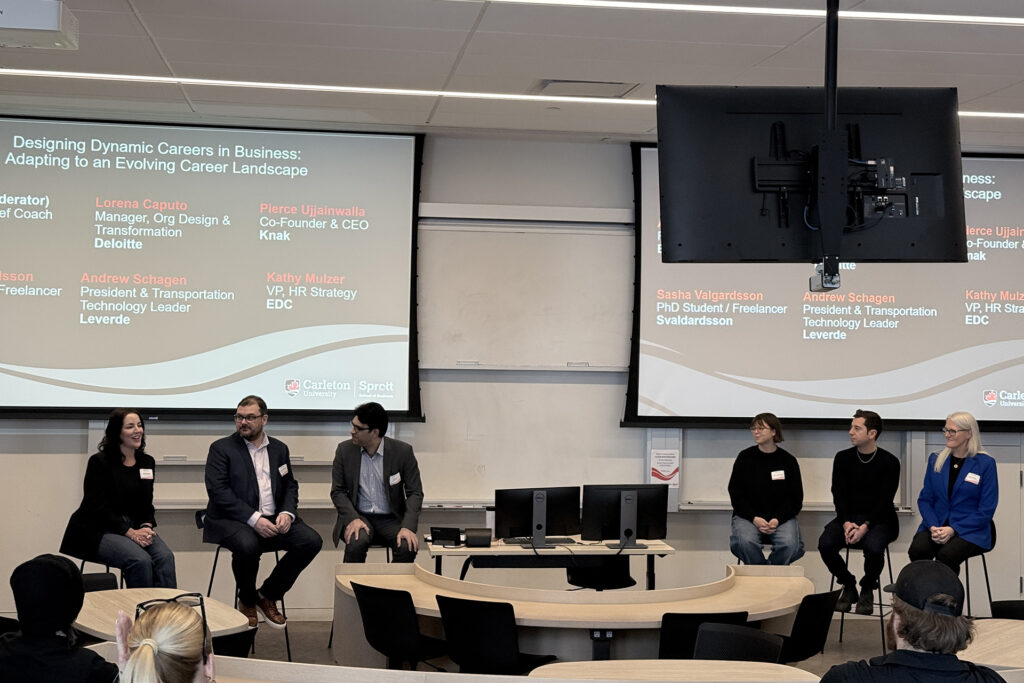
The panel discussed valuable skills that are transferable to a variety of careers and advised strong communication and being able to make a compelling argument is crucial to building relationships with colleagues, leadership and stakeholders. Students were challenged to initiate conversations because they could lead to opportunities.
“Be open to change,” added Mulzer. “Being flexible goes a long way. Apply for all the jobs. Don’t limit yourself early in your career. Get a foot in the door.”
Ongoing learning versus learning on the job was discussed and panelists agreed that it is wise to get work experience before upgrading skills and credentials. Certifications are a useful tool to advance or pivot careers.
“Doing an MBA didn’t get me a business job,” said Schagen. “It gave me the skills and confidence to get the job I wanted. If you stop learning, you get stuck in time.”
The panel also discussed the importance of having an entrepreneurial mindset. Early in one’s career, an entrepreneurial mindset shows up as curiosity and initiative. There is value of being an intrapreneur within an organization – identify the gaps, be creative, take risks and advocate for change.
When thinking about entrepreneurship, many focus on the risks and believe that one has to go all in from the start. Ujjainwalla spoke to taking calculated risks when he was branching off into entrepreneurship. He started with working on his business one day a week and working at his paid job four out of five days a week. Shagen added that in entrepreneurship, it is s critical to identify your skillset, play to your strengths and build a team that complements you. Not everyone is the CEO, marketing or tech lead.
In addition to the panels, Sprott students networked with recruiters and representatives at the career fair and attended employer information sessions throughout the day.